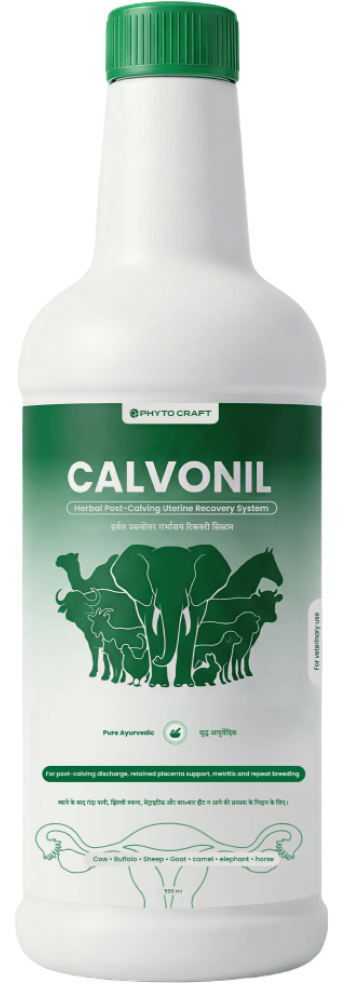
Calvonil
Herbal Post-Calving Uterine Recovery System
Calvonil is a pure Ayurvedic uterine recovery system for livestock — built for the biological stage after calving or uterine infection treatment where the uterus remains internally compromised even after the visible crisis has passed. After delivery, the uterus must cleanse itself, repair its lining, restore its muscular tone, and re-establish the hormonal rhythm that governs the next reproductive cycle. Without systematic support at this stage, retained discharge, incomplete tissue repair, and hormonal instability silently set the foundation for repeat breeding, irregular heat cycles, and persistent reproductive failure.
Why the Uterus Remains Vulnerable After Calving
Parturition is not the end of biological risk — it is the beginning of a secondary recovery phase that most livestock protocols ignore entirely.
Uterine Involution Failure
After calving, the uterus must contract back to its pre-pregnancy size within 21–30 days. Without oxytocin rhythm and smooth muscle tone, involution stalls — trapping lochia, promoting bacterial growth, and blocking the next ovulation cycle.
Retained Fetal Membranes
RFM occurs when the placentomes fail to separate cleanly post-calving. This sets off a cascade of endometritis, systemic toxemia, and prolonged anovulation — often the root cause of repeat breeding in dairy herds.
Sub-Clinical Endometritis
Even when visible signs of infection resolve, sub-clinical endometritis persists in 30–50% of post-partum cows — silent inflammation that impairs embryo implantation and first-service conception rates without any obvious external symptoms.
Hormonal Dysregulation
Post-calving stress suppresses GnRH pulsatility, delaying the LH surge required for first post-partum ovulation. This translates to extended calving intervals, irregular heat expression, and poor conception to first AI.
Uterine Microbiome Imbalance
The post-calving uterus is not sterile. Opportunistic colonization by Trueperella pyogenes, E. coli, and Fusobacterium necrophorum disrupts the endometrial microbiome and triggers chronic inflammatory cascades that persist through the next estrus cycle.
Antibiotic Dependency Trap
Conventional protocols rely on intrauterine antibiotic infusions and prostaglandin injections that address bacterial load but do nothing to restore tissue integrity, stimulate endometrial regeneration, or re-establish hormonal rhythm — leaving the animal vulnerable to recurrence.
Six Biological Functions Calvonil Rebuilds
Uterine Involution
Stimulates smooth muscle contractility and oxytocin sensitivity to accelerate the physical contraction of the uterus back to its non-pregnant dimensions post-calving.
Faster Uterine ReturnEndometrial Regeneration
Provides phytoestrogens and tissue-healing saponins that support re-epithelialization of the endometrial lining — restoring the implantation surface for the next pregnancy.
Restored LiningAnti-Inflammatory Action
Reduces prostaglandin-driven uterine inflammation and chronic endometritis through polyphenolic and alkaloid compounds with demonstrated anti-inflammatory activity in uterine tissue.
Reduced InflammationHormonal Re-Synchronisation
Restores hypothalamic-pituitary-gonadal (HPG) axis function post-calving — supporting GnRH pulsatility, LH surge timing, and return to estrus within the target window.
Estrus NormalisedAntimicrobial Defence
Phytochemicals with proven activity against Trueperella pyogenes, E. coli, and Fusobacterium control post-partum uterine bacterial load without disrupting the developing endometrial microbiome.
Pathogen ControlledLochia Clearance
Enhances uterine secretory activity and mucociliary clearance to evacuate retained lochia and inflammatory exudate — preventing the toxic accumulation that drives systemic illness and reproductive failure.
Clean Uterine EnvironmentFive-Herb Uterine Recovery System
Every herb in Calvonil is selected for a specific and documented role in post-partum uterine recovery — no fillers, no tonics, no marketing herbs.
Ashoka
Saraca asoca — Uterine Tonic
Lodhra
Symplocos racemosa — Astringent & Anti-infective
Shatavari
Asparagus racemosus — Hormonal Regulator
Punarnava
Boerhavia diffusa — Anti-inflammatory & Diuretic
Dashamoola
Ten-root formulation — Systemic Recovery Base
The Uterine Recovery Mechanism
Calving / Infection
Uterine compromise initiated
Involution Failure
Lochia retention + bacterial load
Endometritis
Sub-clinical inflammation persists
Calvonil Administered
Multi-herb recovery protocol
Uterine Repair
Tissue + hormonal restoration
Return to Estrus
Normal cycle re-established
Uterotonic Action
Ashoka and Dashamoola compounds stimulate smooth muscle contractility via oxytocin sensitisation, driving physical involution and expulsion of retained material.
Endometrial Repair
Phytoestrogenic saponins from Shatavari and Ashoka support re-epithelialization and glandular regeneration of the damaged endometrial lining.
Anti-infective Barrier
Lodhra alkaloids and Punarnava flavonoids reduce pathogenic bacterial colonisation and control the inflammatory cascade without disrupting the developing endometrial microbiome.
HPG Axis Restoration
Shatavarin compounds and Dashamoola adaptogens normalise GnRH pulsatility and LH surge timing — the rate-limiting step for return to first post-partum ovulation.
When to Use Calvonil
Indicated For
Post-Calving Recovery
Routine post-partum uterine support from day 1 to day 21 to prevent involution failure and sub-clinical endometritis.
Retained Fetal Membranes
Adjunct therapy alongside manual removal to clear residual endometrial infection and restore uterine tone.
Sub-Clinical Endometritis
Silent post-partum uterine inflammation identified by reproductive examination or fertility performance data.
Repeat Breeding
Cows with 3+ failed services despite normal ovarian function where endometrial compromise is the underlying cause.
Post-Treatment Recovery
Following antibiotic uterine infusion to restore endometrial integrity and re-establish hormonal rhythm.
Irregular Heat Cycles
Delayed or silent heat in post-partum animals due to HPG axis suppression and uterine sub-optimal environment.
Not Indicated For
Active Pyometra
Closed-cervix pyometra requires prostaglandin-based cervical opening before any uterine herbal support is initiated.
Acute Metritis
Systemic illness with fever requires immediate antibiotic and supportive therapy; Calvonil is a recovery agent, not an acute treatment.
Pregnancy
Not for use during gestation; uterotonic properties contraindicate use in pregnant animals.
Pre-Calving
Calvonil is designed for post-partum recovery — administration before delivery is not indicated or supported.
What to Expect — Week by Week
1–3
Involution & Clearance Phase
3–5
Endometrial Repair Phase
5–7
Hormonal Re-entry Phase
7–9
Fertility Readiness Phase
Calvonil Administration Guide
| Species | Indication | Dose | Frequency | Duration | Route |
|---|---|---|---|---|---|
| Cow / Buffalo | Post-calving routine recovery | 30–40 ml | Twice daily | 21–30 days | Oral |
| Cow / Buffalo | RFM / endometritis recovery | 40–50 ml | Twice daily | 30–45 days | Oral |
| Sheep / Goat | Post-lambing / kidding recovery | 10–15 ml | Twice daily | 14–21 days | Oral |
| Camel | Post-partum uterine support | 50–60 ml | Twice daily | 21–30 days | Oral |
Administer mixed in feed or drench directly. Best given within 12–24 hours of calving for maximum involution benefit. Adjust dose based on veterinary assessment of uterine status.
Five Stages of Uterine Restoration
Immediate Intervention
Begin Calvonil within 12–24 hours of calving or at first sign of retained membranes. Early intervention prevents lochia stasis and sets the foundation for rapid involution.
Physical Clearance
Active uterotonic phase drives lochia expulsion and uterine contraction back toward baseline size — visible as reduced discharge and improved body condition.
Infection Neutralisation
Anti-infective phytochemicals suppress pathogenic bacteria and resolve sub-clinical endometritis before it establishes chronic inflammation.
Tissue Regeneration
Phytoestrogenic and regenerative compounds rebuild the endometrial lining — restoring the implantation surface to functional readiness.
Hormonal Reboot
HPG axis adaptogens normalise GnRH → LH signalling, triggering first post-partum follicular wave and estrus expression within the target 45–60 day window.
Safe Use Guidelines
Precautions
- Do not use during pregnancy — uterotonic activity contraindicated in gestating animals.
- Not for use in cases of active pyometra or acute metritis without concurrent antibiotic therapy.
- Consult a veterinarian before use in animals with systemic illness or fever.
- Keep out of reach of children.
- For veterinary use only.
Storage
- Store in a cool, dry place away from direct sunlight.
- Keep below 30°C. Do not refrigerate.
- Shake well before use — natural sedimentation may occur.
- Use within 30 days of opening.
- Do not use beyond printed expiry date.
Frequently Asked Questions
Answers to the clinical and practical questions most commonly asked about Calvonil.
Related Products
Connect with PhytoCraft
If you believe animal health deserves more depth, more honesty, and more compassion — you are already aligned with our purpose.